
 I must have been 12, maybe 13, when Ma demanded that I step foot in the kitchen and help her make our traditional style of Indian roti – ‘Per,’ with the ‘per’ being somewhere in between par and per se, and the ‘r’ of the per being somewhere between an ‘r’ and a ‘d.’ I’ve never seen any other Indian household outside my little religious community in India ever make their rotis this way, and Ma doesn’t really know the origins of per, other than she had been cruelly pushed in front of the fire to roll these out as a young girl too.
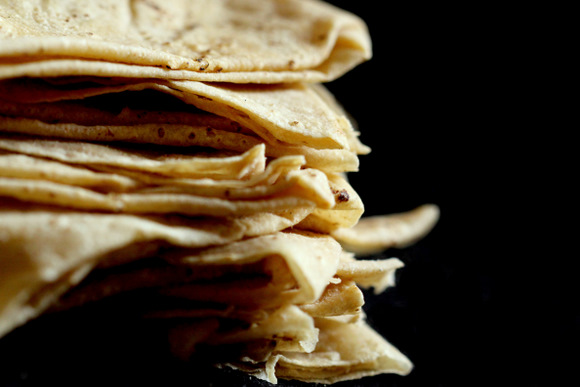
True to the word per, which in Hindi means wings, these were sheer folds of wheat dough, cooked by rolling out two rotis stuck together with a thin film of oil in between, and then separating the two rounds only after you’d cooked them on the fire. The perfect mark of a well-made per is one that feels unbelievably light, like an ephemeral messenger of some other more potent flavor in your mouth, be it daal or chicken curry or whatever else you could sop up with it. Made of wheat flour and minimal oil, it’s one of the healthier versions of Indian bread that’s out there.
I fought. I struggled. I threw tantrums. Making per made me feel like I was succumbing to the typical Indian wively stereotype, and I refused to do that while guys my age were out doing…doing whatever guys do at that age. And to make matters worse, it was actually ridiculously HARD to make these rotis:
- If you rolled out the two stuck-together per or roti discs slightly too thin or too thick, as measured by Ma’s exacting vernier caliper glare, they wouldn’t separate after the cooking process. I’ve often ripped apart poorly rolled per, and the torn results are quite unsightly to say the least.
- Once Ma slapped the per onto the griddle, she proceeded to flip it over in all different directions with her bare hands. My first few times in the kitchen, she graciously offered me a spatula…but that just felt lame in light of her fiery daredevil tactics. I opted for the burn treatment instead, a choice that has effectively desensitized the nerve-endings in my finger tips for the rest of time.
- The two fused rotis can only separate when they have been puffed apart with steam that builds up on the inside, after heating them on the griddle. As soon as the per is cooked and pulled off the griddle, you’ve got to peel apart the two rotis from each other, standing firm with all the Herculean strength you can possibly muster as scorching steam escapes from between the two rotis and billows right into your fingers and your face.
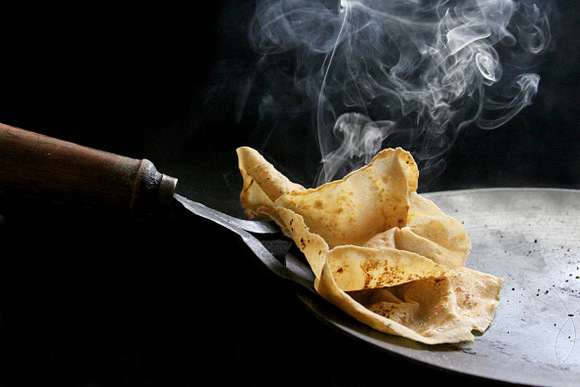
It was BRUTAL. Most of the times I wouldn’t even reap the fruit of my burns…unless you count those raggedy forms riddled with singed black holes that we’d try to heap together neatly for lunch on the days I’d made an appearance in the kitchen. But when mom made these beauties, I’d rush to her side with an empty eager plate, hoping to have a feather-soft sheet of bread slide into my plate so that I could enjoy it at its freshest, softest peak – with eggs, with veggies, with tea, with anything, or even with nothing, just piping hot and full of earthy, toasty flavor.
Given how inept I can be in the kitchen, it’s not surprising that after all these years, I am yet to master the perfect, hole-free per. It still takes me a couple of torn shredded pers before I can get the last few in the batch right. For the fearless masochist cooks out there looking for their latest culinary challenge, go ahead, give this recipe a shot.
‘PERS’- A VARIATION OF TRADITIONAL INDIAN ROTI
Servings: 16 – 18 individual per
Ingredients:
250g of whole wheat flour, and some additional to use while rolling out the pers
1/2 tsp salt
Warm water to add to the dough
Vegetable oil
Directions:
- Mix together the whole wheat flour, salt, and drizzle in little bits of water as you knead the dough.
- How do you know when to stop kneading? When the flour has compacted together into one mass. That mass is not wet, nor is it overly hard and dry. If you prod your finger into the dough, it leaves a subtle impression.
- Cover the dough with a towel and leave it aside for around 30 minutes or so.
- Roll the dough out into a log, and then break away pieces of dough from it to make 16-18 tiny balls, each around 4 to 5 cm in diameter.
- Flatten the balls into mini discs with your fingers.
- Pick up one disc (disc A) by pinching it up from the top, and dip the bottom surface lightly in oil. Place disc A right on top of another un-oiled disc (disc B), with its oiled face directly in contact with the un-oiled disc so that the oil gets transferred to disc B as well. This oil film between the two discs will ensure that both discs get cooked thoroughly when heated on the griddle.

- Flatten the two discs down so that they both stick to each other, like a sandwich, and then dust the fused discs in flour.
Repeat steps 6-7 with the remaining pairs of discs.

- Heat a griddle or ‘tawa’ on high flame.
- On a floured surface, roll out each set of fused discs into 24 cm rounds. Keep dusting with flour lightly as and when you feel the discs sticking to the surface, and ensure that you roll the discs out evenly. Once rolled out, don’t be alarmed that the two separate discs don’t look separate any longer – that’s exactly how it should look, the discs will only separate once the per has been cooked. Tip: As the disc grows larger, you would have to focus more on rolling just the edges – excessive rolling in the center will make the per too thin and susceptible to tearing at the middle.
- Dust off any additional flour from the per and slide it onto the heated griddle.
- You should immediately see air bubbles popping up on the surface of the roti. After 3-5 seconds, or once you start to see the first specks of browning, flip the per over.
- The center of the per cooks much faster than the edges, probably within the first 10 seconds. After the initial flip over, wait for another few seconds, and then move the per off-center so that only one of its semi-circular edges is directly on the center, hottest part of the griddle. Quickly rotate the per so that all the edges see the center of the griddle, and get cooked thoroughly.


- Take the per off the griddle, and lightly crumple it up in your hands (yes, right when it’s off the griddle – it’s easiest to separate then. If you have sensitive hands, crumple the roti in between the folds of a thin towel). Usually, the per is too hot to hold for longer than a second, so we keep tossing it between our hands as we crumple it up)
- The tossing/crumpling action will get the two discs to separate into two thin super-soft rounds, which can then be folded into half, and then quarter, such that it looks like a triangle.
- Stack up the triangles, dish out your favorite curry, tear off a morsel of per, and dip right in.

Storage: If we eat the per the same day it’s eaten, we just leave them tucked under a towel in a box outside the fridge. They just need to be heated for 30-40 seconds, and they’re back to their natural tender selves. If we keep them for a day or two, or even three for that matter, we store them in a plastic container in the fridge and just reheat them in the microwave when it’s mealtime (I think I’ve even left them in the fridge for over a week when I was crunched for time back in NYC).
(On a versatile side-note: Ma says that if you undercook the per slightly, you can actually cut up the separated rounds into strips and stuff them up with filling for samosas. The side of the per that’s been in direct contact with the tawa should be used as the inside face of the samosa, i.e. the surface on which you’d spread the filling. The inner side of the par that was originally pressed against its fused partner per should be used as the outer side of the samosa. Once you’re done with the filling and have sealed the samosa, you can fry or bake as you normally would.)
These photos!! They’re amazing! Love that dark background.
I wish I could have these for breakfast, they look as light as you’ve described them! I must try these someday!
And these photos, I’m just speechless. They’re fantastic!
Holy Smoking photos batman! Now that’s what you call an amazing shot or five!! It’s pretty funny actually my grandma used to make roti’s in a similiar way when I was young but I just presumed it was her own style because my mom can’t even make normal roti’s! While I love roti’s, my attempts or anything in this department have always resulted in astounding failure.
Not even going to attempt this, but some next level shots there!
@Nausheen – Thank you, I decided to experiment with dark backgrounds this time so glad it worked!
@Yasmin – mmm, yes, I would have them for breakfast so often, usually on vacation when I would roll out of bed and waddle into the kitchen to be greeted by fresh bread and hot tea. Would just eat ’em plain. GOD I love mommy food.
@CompleteFoodie – If you’re grandma made the same ones, t…t…then Robin, we have some ancestral connection here! Where’s your grandma from? *hopeful*
arva… always love to read about traditional/lesser known food. you should write more abt stuff like this… we make parathas like this, and i always pull off the layers while eating. but this must be really silky, will love to try it and will let you know how it tuns out.
Wow – I need to know how you did these pics.
Well written and guess you must share some more of Mom’s cookings with others – like "Mirchi Ka Salan"
Arva, these are fantasic! Great pics too. I wonder if you can make them gluten-free, any ideas?
@Rajani – ohhhh, soft buttery layered parathas! Now those I love dearly too…but I may actually be even more incompetent at making those. Don’t you have to fold them up into some sort of funky triangle / prism / hard-ass shape before flattening it and rolling it out with just the right pressure so that the layers don’t stick back together too firmly? Wish I could come up with such an awesome food invention some day…
@Sally – the truth? Mommy made the pers, I stole the recipe, and I snapped away like there was no tomorrow! The last time I made pers was around a year ago…to my credit, they actually were 90% free-of-holes/burns!
@Dad – I took this suggestion and asked her. She refused point-blank. She’s declared that no more culinary secrets will be shared henceforth with me, lest I post them all up over the internet again. The recipe treasure chest has slammed shut in my face, just like that. :(
@mymezzaluna – Mom and I deliberated over this a bit…I mean, we do use alternative flours, jowar (english name: sorghum) for instance. But the texture of the roti is much thicker, and very, very different in taste (maybe a slight bitter tinge with sorghum)…nonetheless, it’s a wonderfully earthy, very rustic type of bread that I should probably write about some time. *mental lightbulb flickers on*
Awesome stuff! In fact, the Gujratis traditionally make rotis the same way – with the rolling and splitting after cooking. Sadly they smear the thing with ghee afterward and is probably the leading cause of cholesterol among ’em :)
Brilliant pictures indeed and a great writeup as always!
superb pics. Think I might just buy my roti after that though…
OH MY GOD. These roti make me salivate, your pictures are breathtaking. Please, Arva, open a cooking cum photography school and be my teacher! And I want that pan.
photos are magical!! love the one with the smoke!
@chiragnd – You know, I had a feeling there was some Gujrati connection here because I have heard of their super-thin..is it ’rotlis’? And our community did originally descend from Gujrat, so maybe this is a Gujrati thing. Glad that we lost the ghee though, I think ghee on parathas is consistent, ghee on soft airy rotis would sort of drown out the light, ’wing-like’ experience.
Thanks for the info!
@sarah – haha, good call there, or find someone (aka mommy in my case) who can make ’em for you cause these ones would be nearly impossible to find in restaurants in Dubai!
@AnjasFood4Thought – Wha…?! I’m SO flattered, seriously, from someone like yourself who’s a photo pro and creative recipe designer. I appreciate the wonderful words, but if anyone needs to open a school honey, I’m lookin’ right at you. ;)
@Sidiqa – thank you! trust me, the only magic around here is the one that ma does in the kitchen. I’m just her bumbling apprentice.
Fantastic lead..and great follow through. The article flowed well and the photos were bang on! A+ for you Arva!
That’s exactly how I made my Peking duck pancakes! But instead of crumbling, I threw them hard against the counter to induce more separation of the 2 halves.
Superb photos!
PS – next time I make Peking duck, I think I should make the duck and invite u over to make the pancakes a my first attemps all turned out quite disastrous.
Beta ’per’ is so easy to make! you make it sound like it is impossible. I am sure many out there
might have already tried and were successful.
Don’t forget unlike the other rotis/breads it can keep for days without becoming tough. A little reheating and back to the fresh ’pers’ of the first day!
Don’t forget it is a very good exercise for the hands – strengthens your musles when large quantities are made ( like we used to do when living in a joint family!
@chefandsteward – yay, my first A+! after all these years, finally! Mom would be so proud of me [teary moment].
@SD-b – OOOO I would LOVE to make pers for a slice of your peking duck, brilliant, brilliant idea. A nice saucey piece of duck would actually justify the per’s finger burn treatment. Just holla’ and I will be there.
@Ma – Oh Ma, as always, sage advice and words of encouragement for your inept, banana-fingered daughter. If only I could stop bungling around, toughen up those muscles, and become a per-producing pro someday.
Hi Arva
Thanks for the email, it was a pleasure your food photography is great. I use Gravatar to upload an image with the comment for some recent it did not work on the last one- see if this works. Kind regards
Grant
@Grant – hm, no photo except your profile thumbnail as a commenter….feel free to send me the image over email!